


I admit, the title sounds ambitious. However, the logic of analyzing cause-and-effect relationships inevitably leads us to fundamental principles—to the architectonics of reality itself.
Any system, by definition, possesses an architecture. This holds for natural formations (physical, chemical, biological, mathematical) as well as for social, religious, or political structures. Few would dispute this.
At the same time, we must consider that many objects, despite their apparent uniqueness and independence, function as components of other, more complex and higher-level formations. Such connections often remain non-obvious, primarily due to the deepening specialization in science that defines the vector of modern scientific and technological progress. This is natural.
As an illustration, consider our own body—a convenient example, as it is close at hand. Each cell of the organism is itself an extremely complex structure, yet it serves only as a microscopic element of a higher-order system. All these levels of organization combine into a single whole, which we call the human body. If we add consciousness and a spiritual principle to this material basis, the result is the human being as a complex spiritual-physical structure, itself forming part of an even higher-level system.
A similar hierarchy is traced in the natural sciences. Newtonian (classical) mechanics turns out to be a special case (or limiting approximation) of the more fundamental quantum mechanics. It is quite probable that other natural science disciplines demonstrate a similar subordination of theories. Moreover, even within physics, there is no basis to assert that modern quantum mechanics has reached the pinnacle in describing the physical world. And there is even less reason to believe that it could not itself be an element of some broader, more fundamental concept. This applies to absolutely all modern scientific, socio-political, religious, and philosophical teachings.
On the other hand, each subsystem—to one degree or another—reflects the architecture of the higher-level structure or supreme supersystem. Here, the concept of fractals manifests, according to which the structure of the higher order is reproduced in every primary element.
This question, albeit indirectly, was touched upon by H. Bergson in his works "Creative Evolution" and "The Two Sources of Morality and Religion." Examining the convergence of the evolutionary process, the philosopher asserts: "...it proves not the existence of some 'law,' but the presence of limits. Life is not infinitely plastic—matter sets boundaries. However, the choice of path within these constraints remains free and unpredictable. If convergence were absolute, all branches of evolution would have merged into one long ago. This does not happen. Consequently, the law is one, but its embodiment is always unique. Thus, each subsystem, possessing its own uniqueness, also carries common features."
Attempts to create a model of the universe have been made since ancient times. However, as philosophical thought developed, they increasingly shifted toward anthropocentrism—a process perhaps natural, but with an important consequence. By placing man, with his extremely limited capabilities, at the center, anthropocentrism inevitably imposed the stamp of limitation on all cosmological constructs created. The leading philosophical schools of Western Europe were aware of this problem, prompting them to seek justifications for the imperfection of human cognition itself.
The modeling process itself can reasonably be defined as a "bottom-up" movement, which predetermines the narrowing of the final result. Examining the "supersystem" of the universe is impossible from the standpoint of one subsystem or even a whole cluster of them. This assertion rests on one of the key postulates of Henri Bergson's philosophy, according to which any science is based on a "frame-by-frame" analysis of conditions associated with a particular phenomenon, while the behavior of each element represents a continuous vital process.
For these very reasons, it seems more logical to construct a model according to the "top-down" principle, i.e., identifying fundamental requirements and examining their implementation both in the general supersystem and in the underlying structures. In this aspect, it is appropriate to refer to a quote from one of the most outstanding inventors and thinkers of the recent past, Nikola Tesla:
"If you want to find the secrets of the universe, think in terms of energy, frequency, and vibration."
I would like to note that the statements of such people are tens of times more valuable than the reasoning of philosophers, even such as Hegel, Kant, or Bergson. The reason is that they are creators and builders, whereas historians or philosophers belong more to the category of speculative thinkers, whose contribution to the development of human civilization is less obvious and requires strong evidence.
Secret number one: energy
We often use the term "energy." Yet few people ponder the nature of this phenomenon itself. In this regard, it makes sense to examine the concept in as much detail as possible.
Definition: "Energy (from Ancient Greek ἐνέργεια (enérgeia) 'activity, operation') is a scalar physical quantity that represents a single measure of various forms of motion and interaction of matter, a measure of the transition of motion of matter from one form to another. Introducing the concept of energy is convenient because, in the case of a closed physical system, its energy is conserved within that system over time as long as it remains closed. This statement is known as the law of conservation of energy. From a fundamental point of view, energy is one of three (along with momentum and angular momentum) additive integrals of motion (i.e., quantities conserved over time) associated, according to Noether's theorem, with the homogeneity of time, in other words, with the independence of the laws describing motion from time. The word 'energy' was introduced by Aristotle in his treatise 'Physics,' although there it denoted human activity."
a. Hypotheses of the Unitary Quantum Field Theory:
Interesting hypotheses have been proposed by one of the founders of the Unitary Quantum Field Theory (UQFT), L. G. Sapogin. Although this theory has not yet received full recognition today, it has nevertheless allowed predicting a number of new experimental effects for both high and low energies. The fine structure constant (1/137) was calculated in 1988, and the masses of numerous elementary particles, starting with the electron, were estimated in 2007 with an accuracy of less than 1%. Two pentaquarks, the θ⁺-baryon, the Higgs boson, and a particle with an energy of 28 GeV, predicted theoretically, were discovered 11 years later—all calculated with high accuracy. The general picture of the world offered by UQFT is based on a single unitary field. The equations of the theory allow for the emergence of the Universe without a Big Bang. Gravity ceases to be a mystery. Interest in UQFT is steadily growing. More details of UQFT can be found in the article "New Quantum World" authored by L.G. Sapogin. (Citation: Sapogin, L. G. (2026). New Quantum World. I J T C Physics, 7(1):1-39. DOI: https://doi.org/10.47485/2767-3901.1070)
b. Consequences:
According to this theory, particles are wave packets that periodically appear and disappear without changing shape. In simple terms, a particle alternately "smeared out" across the Universe and then gathers back together in its original form. If an individual particle is undoubtedly a limited part of space, i.e., matter, then during its dispersion, this matter loses its spatial limitation and spreads throughout the entire Universe, and the particle's energy is also distributed, creating fluctuations in the physical vacuum.
This hypothesis leads to the conclusion that a particle is "condensed energy," whereas in dispersed form, matter loses its spatial limitation. Thus, energy is dispersed matter, and a particle is condensed energy. In both cases, we are talking about matter.
Attention must be paid to the problem of the level of energy condensation, which ranges from extreme concentration, for example, in "black holes," to very low, as in microorganisms or elementary particles.
Furthermore, dispersed matter—energy creates an energy field in which the corresponding particle resides. This closes the dialectical connection—cause and effect. In other words, every material object—condensed energy—creates its corresponding energy field.
Correlation of UQFT and the Philosophy of H. Bergson:
The assertion about the particle as "condensed energy" and energy as "dispersed matter" surprisingly resonates with key intuitions of Henri Bergson's philosophy, although he, of course, did not write about quantum physics in the modern sense. The connection can be traced along several lines.
1. "Smearing" and "Duration" (La Durée)
For Bergson, the fundamental reality is not a discrete state (point, particle), but a continuous flow—duration. Reality flows, and our intellect, according to Bergson, is "cinematographic": it snatches individual "frames" (instantaneous states, particles) from the continuous movement.
UQFT: The particle alternates between being "smeared out" and gathering together. This resembles a description of a process where the stable state is merely a temporary "stop" in the flow.
Correlation: Bergson would say that the "gathered" state of a particle is an illusion of our perception (or instrument), cutting a moment out of the continuous process of dispersion. Reality itself (energy/matter) resides in constant becoming.
2. Matter as "Clot" and "Image"
In "Matter and Memory," Bergson introduced the concept of "image." For him, matter is a collection of "images" existing objectively. He distinguished between:
Perception: which cuts out from the continuous field what is useful for action (i.e., "condenses" reality into separate objects).
Memory: which encompasses duration.
UQFT: A particle is "condensed energy" (a clot), and the dispersed form is pure potentiality (field).
Correlation: This is an almost literal description of Bergson's model. Matter (particle) exists where compression (condensation) of the universal field occurs. What UQFT calls the "energy field," Bergson might have called "reality as such"—before its division into objects by our perception.
3. Cause and Effect: Dialectical Connection
Bergson was an opponent of rigid mechanistic determinism. He argued that cause and effect are inseparable and belong to a single flow.
Correlation: In the UQFT model, a particle (concentrate) creates a field, and the field (dispersion) creates a particle. This is precisely what Bergson would call "creative evolution" at the micro-level: cause does not precede effect in time; they coexist as two aspects of a single process. The field acts as the potentiality of the particle, the particle as the actualization of the field.
4. Critique of "Emptiness" and the Concept of Field
Bergson criticized the idea of absolute emptiness. He considered the notion of "nothingness" a pseudo-idea. Where we see emptiness, there is actually something else (e.g., a field).
UQFT: During dispersion, energy creates fluctuations in the physical vacuum. The vacuum is not empty.
Correlation: Bergson would fully support this idea. For him, "nothingness" is merely the absence of the thing we need, not the absence of reality. In UQFT, the "energy field" ideally describes the Bergsonian fullness of being, in which there are no voids.
5. "Élan Vital" and Energy
Although Bergson used the term "vital impetus" in biology, it can be extrapolated to physics. Élan vital is a creative energy constantly producing new forms.
UQFT: Energy is primary, the particle is a temporary form.
Correlation: In the UQFT model, energy acts as a universal substance, which is close to Bergson's idea of a single flow that, by "condensing," generates matter, and by "rarefying," generates free action or spirit.
c. Result: How does this correlate?
The above reasoning can be considered a natural-scientific projection of Bergson's philosophy onto quantum reality.
If Bergson speaks of duration (continuity), then UQFT speaks of the field (dispersion) as the basis.
If Bergson speaks of matter as a "clot," then UQFT speaks of a particle as a condensate of energy.
If Bergson criticizes the intellect for stopping the process, then UQFT describes the process of "smearing-gathering" lying behind the appearance of a stable particle.
The only thing Bergson might have disputed is the claim that speculative philosophers are less valuable than inventors. He himself believed that the philosopher's intuition could penetrate reality more deeply than the scientist's analysis. However, the proposed hypothesis precisely demonstrates a synthesis, where scientific data (UQFT) is used to illustrate a profound philosophical intuition about the unity of matter and energy, which is entirely in Bergson's spirit.
Thus, the presented reasoning not only is correct but also serves as a convincing example of how modern physics begins to speak a language close to the intuitive philosophy of the early 20th century.
The conducted analysis allows us to reasonably assert that UQFT is effectively supported by philosophical research, and on the other hand, Bergson's philosophical model finds justification in fundamental research in quantum physics—once again, a dialectical connection in action.
Secret number two: frequency and vibration
Strictly speaking, Nikola Tesla should have swapped the words—vibration and frequency—since vibration represents the periodic back-and-forth motion of matter, and frequency is just one parameter of this motion, along with amplitude and phase. Thus, vibration is primary, frequency is secondary. But this is not so important...
So, the entire Universe can be viewed as an energy field with individual inclusions of condensed energy in the form of stars, planets, living and non-living organisms, elementary particles, and so on. Most importantly, this energy field serves as a medium for transmitting vibrations and energy between condensation objects. And since the field consists of many dispersed energies, this automatically conditions the existence of different types (or classes) of condensed energies, i.e., forms of matter.
The speed of disturbance propagation in the energy field is not limited by the speed of light, which in quantum physics is considered the maximum possible. Referring again to the previously cited article by Prof. Sapogin: "...The most interesting were studies [27, 32, 34] in which Li Ziyang Wang discovered a speed 310 times higher than the speed of light (Fig. 7). A similar fact was discovered back in 1965 by G. Basov [84], but there was no explanation for it then. Li Ziyang Wang gave the same interpretation as we did, but only for a light pulse. In this case, it was an incorrect interpretation, as the envelope of the light pulse was not distorted in the experiment, and Wang noticed this surprising fact. He suggested that the special theory of relativity was completely destroyed. But this is not entirely true..."
However, it must be considered that exceeding the speed of light by 310 times was detected for a single or limited set of conditions, which allows for the possibility of other, possibly more significant, exceedances. If we consider the field not as an elastic medium in which oscillations propagate at a finite speed, but as something integral, where disturbance occurs simultaneously at all points in space, then any finite speeds become merely special cases. This can be illustrated by the example of a stone falling into water. Circles spread from it at a finite speed. If the medium were a single and indivisible whole, then the circles from the stone would not spread out but would arise simultaneously.
An important property of the energy field is its ability to serve as a medium for interaction between condensation objects that are in different states of energy compaction. Here, the "impenetrability" of solid objects is preserved only for objects of similar density. This means that different forms of matter can coexist in the same part of three-dimensional space. As a result, the need for additional dimensions completely disappears, and everything coexists harmoniously in three-dimensional space.
Applying the proposed model to the known concept of man as a "bodily-spiritual" object, the conclusion suggests itself that here we have a combination of one form of energy condensation related to corporeality (often called gross matter), and at least one more form of energy condensation of much lower density, which is called spiritual. However, both forms are nothing other than matter!
The last statement can be illustrated by the example of creating an outstanding sculpture, say, Michelangelo's "David."
First, Michelangelo received a block of marble. This marble evoked no emotions in anyone and was, in essence, just a huge piece of stone.
Second—using a hammer and chisel, Michelangelo changed the shape of this stone, transforming it into the statue of David, which has continued to delight people for over five centuries.
To claim that this admiration is caused only by the change in form would be ridiculous. In reality, something more complex happened: by changing the external appearance of a piece of stone—one form of condensed energy—the sculptor attached to this matter another, subtler form of energy condensate—subtle matter emanating from his own subtle matter, his talent. And this subtle matter, with its vibration, has been resonating with the subtle matters of viewers for 521 years, remaining attached to the gross matter of the stone. Expecting this from people with a "callous" soul, or in other words, with suppressed subtle matter, would be futile, just as expecting a chimpanzee to admire the statue...
A similar situation occurs during the consecration of temples, icons, other religious objects, and dwellings.
This phenomenon of interaction between condensed energies can be explained from the standpoint of vibration and frequency, as Nikola Tesla asserted. The subtle matter attached to the statue of David acts as a tuning fork, emitting vibrations into the energy field in which the viewers are located. These vibrations resonate with the "tuning forks" of the perceivers. If the natural frequencies of these tuning forks coincide with the frequency of David's tuning fork, then such viewers experience a feeling of immense admiration. The greater the difference in frequencies, the less pronounced the emotional reaction. It couldn't be simpler...
And here it becomes necessary to cite another quote from Nikola Tesla: "The brain is only a receiver. In the Universe there is a core from which we obtain knowledge, strength, and inspiration. I have not penetrated the secrets of this core, but I know that it exists."
This statement almost completely correlates with the statement of Henri Bergson: "The brain," says Bergson, "is nothing but something like a central telephone exchange: its role is limited to giving a message or getting it clarified. It adds nothing to what it receives. All the sense organs send nerve fibers to it; the motor system is located there, and it is the center where peripheral stimulation connects with one or another motor mechanism."
This idea is also supported by St. Luke (Voino-Yasenetsky), an outstanding surgeon: "The brain is not the 'house of the soul,' but a 'central telephone exchange.'" And he further develops it: "...At the exchange (in the brain), connections are made and broken, signals are sent—these are material processes. But the content of conversations (thoughts, ideas, images) that go through these lines belongs to the soul. If the exchange (brain) is destroyed, the connection with the external world for the soul is interrupted (physical death occurs), but the 'subscriber' (the soul) itself is not destroyed."
Establishing an intellectual connection between Nikola Tesla, Henri Bergson, and St. Luke (Voino-Yasenetsky) is a complex task, as there is no direct evidence of their acquaintance or references to each other. Tesla was a practical engineer, Bergson a metaphysician, and St. Luke a surgeon and theologian. However, they are united by the intellectual context common to the era of the late 19th and first half of the 20th century and a deep opposition to a purely mechanistic, materialistic view of the world.
1. Common Intellectual Fabric
All three, each in their own field, sought to go beyond the boundaries of classical science, which reduced reality to the interaction of material particles. They are united by an interest in the invisible, dynamic foundations of being.
Nikola Tesla (inventor and engineer-physicist) practically demonstrated that the Universe is permeated with energies that can be used. His ideas about the world ether, wireless energy transmission, and space as a medium not subject to linear constraints echo the search for a unified basis of the world.
Henri Bergson (philosopher) created the concept of "vital impetus" (élan vital)—a creative energy underlying evolution and reality. He contrasted intuition, capable of directly grasping this enduring reality, with analytical reason.
St. Luke (surgeon and theologian), being a brilliant materialist scientist, based on his experience and deep reflections, concluded that science studies only the "phenomena," but not the "essences" of the world. He argued that "knowledge is greater than science," and comprehending higher reality (God, spirit) requires other abilities—intuition and faith.
Thus, all three can be considered thinkers who expanded the boundaries of knowledge, insisting on the existence of a reality inaccessible to simple measurement and logic.
2. Direct Connection: St. Luke and Henri Bergson
Unlike the connection with Tesla, the intellectual link between St. Luke and Henri Bergson can be traced quite clearly and is confirmed by the saint's own texts. In his main work, "Science and Religion," he not only mentions Bergson but also actively uses his ideas to construct his own apologetics.
Overcoming Kant: St. Luke writes that "modern philosophers, such as Bergson, Lossky, are already going further than Kant, opening up the possibility of a rational proof of the existence of God." For the saint, this was extremely important, as Kant's philosophy, in his opinion, left the question of God beyond the bounds of pure reason. Bergson, with his doctrine of intuition, provided a bridge to the knowledge of the transcendent.
Intuition as a Path to Knowledge: In his work "Spirit, Soul, and Body," the saint directly references Bergson's understanding of intuition, placing it alongside Pascal's: "What Bergson later finally called intuition, Pascal called the feeling of subtleties, the sense of judgment, feeling, inspiration, heart, instinct." This shows that the saint was well acquainted with the key concepts of the French philosopher and used them to explain the possibility of direct ("heartfelt") knowledge of God, in opposition to the dry "geometric mind."
This resonates with Nikola Tesla's assertion: "Instinct is more important than knowledge. We undoubtedly have certain fine fibers that enable us to perceive truths when logical deduction or any other willful effort of the brain is futile."
3. Conceptual Parallels: Nikola Tesla and St. Luke
There are no direct indications in the found sources that St. Luke read or quoted Tesla. However, interesting conceptual parallels can be drawn between their views, especially in understanding the nature of matter and spirit.
St. Luke, reflecting on the knowledge of the world, points to the subjectivity of our sensations: "The color, temperature, taste we perceive do not exist outside our cognition by themselves... Even matter we cannot know as it is." He speaks of scientific instruments merely extending the limits of our senses, but not eliminating this fundamental limitation.
Tesla, through his experiments with electromagnetic fields and high frequencies, demonstrated that reality is much more complex than it appears to our sense organs. He worked with invisible forces, which are, in essence, that very "hidden" side of matter. In this sense, both of them—the surgeon-scientist and the engineer-inventor—asserted that behind the visible facade of things lies something deeper and more fundamental.
4. Three Thinkers on the Path to a Single Truth
Synthesizing their ideas, we can imagine the following picture:
Tesla gave us a tool (experimental proof), showing that invisible energy is a reality with which we can interact.
Bergson gave us a method (intuition), explaining how human consciousness can directly contact this dynamic reality, not just through instruments.
St. Luke gave us a goal and meaning, connecting these ideas about the invisible world with the Christian teaching about spirit, soul, and God as the Source of being.
St. Luke completes this intellectual triangle, placing the scientist's quest (Tesla) and the philosopher's insights (Bergson) into the context of higher spiritual knowledge, asserting that "science and religion can and should work together to create a better society."
They are united by a common goal—to know the fullness of reality, which is not limited to the material world, and the desire to overcome the gap between "mind and heart," about which St. Luke wrote so poignantly.
Thus, the conducted analysis allows us to formulate the following key conclusions:
Energy as the Fundamental Basis of Being. Following Nikola Tesla, who urged thinking in terms of energy, frequency, and vibration, and relying on the hypotheses of the Unitary Quantum Field Theory (UQFT), we come to understand energy not just as a physical quantity, but as a fundamental substance that, in a dispersed state, permeates all space (the energy field), and in a condensed state forms all forms of matter—from elementary particles to stars and living organisms.
Vibration and Frequency as a Mechanism of Interaction. Vibration (the primary motion of matter) and its frequency characteristics serve as a universal language through which condensed objects (including humans) exchange information and energy via the unified energy field. This explains phenomena such as the emotional perception of works of art, where the creator's subtle matter resonates with the viewer's subtle matter.
The Brain is a Receiver, Not a Generator. The consistent positions of Tesla, Bergson, and St. Luke confirm that the human brain functions as a central telephone exchange (or receiver): it receives, processes, and transmits signals, but it is not the source of consciousness, thought, or spirit. The soul (or subtle matter) remains an independent substance, capable of existing independently of the bodily "equipment."
The Unity of Material and Spiritual. All forms of reality—from "gross" matter to the subtlest spiritual manifestations—represent different levels of condensation of the same universal energy. This dissolves the dualism of matter and spirit characteristic of the mechanistic worldview and opens the way to a holistic perception of the world.
The Value of Synthesis of Science, Philosophy, and Theology. Despite the initial opposition between "inventors" and "speculative philosophers," the analysis shows a deep correlation between Tesla's experimental insights, Bergson's intuitive philosophy, and St. Luke's theological-scientific reflections. Each, going their own way, arrives at similar conclusions about the invisible, dynamic basis of reality. This proves that the most complete knowledge of truth is achieved not within a single discipline, but at the intersection of scientific experience, philosophical intuition, and spiritual revelation.
Ultimately, the proposed model of the world, based on energy, vibration, and frequency, not only agrees with advanced scientific hypotheses (UQFT) but also finds confirmation in philosophical tradition and religious experience, pointing to a single reality underlying the visible diversity of forms.
… In the Universe, there is a core from which we obtain knowledge, strength, inspiration…
So, we have analyzed and substantiated the thesis that the entire Universe is an energy field, and all objects in it are condensed energy. It can be confidently stated: in the Universe, essentially, a continuous dynamic process of transforming energy into matter and back is taking place. From a philosophical point of view, this is nothing other than the inextricable dialectical link of the "negation of negation," or the continuous transition of cause into effect, and effect into cause.
However, the question of the source of energy remains unresolved. That is why Nikola Tesla's thoughts about the core of the Universe remain relevant.
To resolve the question of the Universe's core, it seems appropriate to use ideas from fractal theory, which has interesting points of contact with the philosophy of Henri Bergson. Moreover, there is a direct correlation noted by researchers of his work.
Philosopher Pete A.Y. Gunter, in his article "Bergson, Materialization, and the Peculiar Nature of Space" (2018), directly points out that Bergson's concepts of "variable lived space" and the "dynamic nature of physical matter" can lead to theories of fractal dimension and theories of the creation and expansion of matter.
This is not a coincidence, but a consequence of the deep foundations of Bergson's philosophy, and here is why these ideas correlate:
Critique of "Ready-Made Frames": Bergson criticized the intellect for breaking reality down into separate "frames" (the "cinematographic method"), similar to how we divide space into simple geometric figures. Fractal geometry, unlike Euclidean geometry, precisely describes complex, self-similar forms of nature (clouds, coastlines, fern leaves) that do not fit into these "rigid" frames.
Dynamics vs. Statics: Bergson considered matter not static, but in a process of constant becoming and interaction with the "vital impetus" (élan vital). Fractals, with their infinite detail and complexity arising from simple rules, well illustrate this idea of dynamic morphogenesis.
Thus, fractal theory could serve as that very mathematical language capable of describing the "dynamic character of matter" that Bergson spoke of, and which our ordinary ("Euclidean") intellect, in his view, is not designed to grasp.
Based on this, it is advisable to consider the Solar System as a fractal element of the Universe, since it most likely obeys the same natural laws as other star systems and, along with them, is a subsystem of the Universe.
So, the part of the Universe called the Solar System has its own core—a star named the Sun, which is condensed energy. In the depths of the Sun, a constant transformation of matter occurs. Modern science claims that the Sun's interior is a multi-layered structure consisting mainly of plasma. The main process that makes the Sun a star occurs at its very center, but the matter and physical conditions change as one approaches the surface. It makes sense to examine in more detail what the Sun's interior consists of and how it is structured:
Overall Chemical Composition
First and foremost, the Sun is a giant ball of plasma. In terms of the chemical elements it consists of, the distribution is as follows:
Hydrogen is the main component, accounting for about 73% of its mass and about 92% of its volume.
Helium—the second most significant element, comprising about 25% of its mass.
Heavy Elements—all other elements (oxygen, carbon, iron, neon, nitrogen, silicon, magnesium, sulfur, and others) account for only about 2%. Despite their small proportion, they play an important role in the physical processes inside the star.
Internal Structure: From Core to Surface
The Sun's interior is divided into several concentric layers, which differ in the methods of energy transfer and the state of matter.
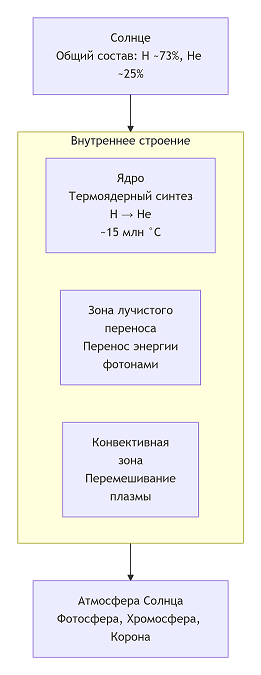
Fig. 1 Structure of the Sun
Let's examine each of the inner layers in more detail.
The Core – The Energetic Heart
This is the central region of the Sun, extending approximately 150-175 thousand kilometers from the center (about 20-25% of its radius). The conditions here are extreme:
State: The matter is in a state of dense plasma. Atoms are completely ionized and cannot exist as a whole, meaning the matter has lost its atomic structure. It is no longer a gas of atoms, but a boiling, electrically charged mass of disparate particles.
Temperature: Reaches 15-16 million degrees Celsius.
Density: Colossal—about 150-160 g/cm³, more than 15 times the density of lead.
Main Process: This is where thermonuclear fusion occurs. During the proton-proton chain (pp-cycle), hydrogen nuclei (protons) fuse to form helium. Every second, about 600 million tons of hydrogen are converted into helium, with about 4 million tons of matter turning into pure energy according to Einstein's formula E=mc².
Radiative Zone
This zone surrounds the core and extends to a distance of about 0.7 solar radii from the center.
Energy Transfer: The energy released in the core in the form of high-energy gamma photons is transferred outward here through successive absorption and re-emission. A photon is constantly absorbed by one ion or atom and then emitted again, but moving chaotically.
Timescale: Due to this "wandering" process, it takes a photon hundreds of thousands or even a million years to make its way through this zone.
Convective Zone
This is the uppermost layer of the solar interior, occupying approximately the last third of the radius (about 200,000 km below the surface).
Mechanism Change: Here, the temperature and density of the plasma drop so much that the gas can no longer effectively transfer energy by radiation. It begins to boil like water in a pot.
Process: Streams of hot plasma rise upward, toward the surface, release heat, and, cooling down, sink back down. This process is called convection. It is the movement of plasma in this zone that generates the Sun's magnetic field.
For clarity, the following data shows the relative abundance of the main chemical elements in the Sun's atmosphere (the data is also characteristic of the interior as a whole). The abundance of hydrogen is taken as 1.
Table 1: Summary Table of Chemical Elements in the Sun's Composition
|
Element |
Relative Abundance (relative to hydrogen) |
|
Hydrogen (H) |
1.00 |
|
Helium (He) |
6.2 × 10⁻³ |
|
Oxygen (O) |
6.8 × 10⁻⁴ |
|
Carbon (C) |
3.7 × 10⁻⁴ |
|
Neon (Ne) |
2.8 × 10⁻⁴ |
|
Nitrogen (N) |
1.1 × 10⁻⁴ |
|
Iron (Fe) |
2.5 × 10⁻⁵ |
|
Silicon (Si) |
3.5 × 10⁻⁵ |
|
Magnesium (Mg) |
3.5 × 10⁻⁵ |
|
Sulfur (S) |
1.6 × 10⁻⁵ |
The table shows that hydrogen and helium are the absolutely dominant components, while the abundance of all other elements is orders of magnitude lower.
Thus, the Sun's interior is a giant thermonuclear reactor running on hydrogen fuel, surrounded by multi-layered "insulation" of plasma that slowly transports energy outward.
The Sun produces energy in a huge range of forms and spectra. All this diversity is a consequence of a single process—thermonuclear fusion in the core—but as it moves outward, the energy transforms.
Conventionally, all the energy produced by the Sun can be divided into the energy of electromagnetic radiation and the kinetic energy of particles.
1. Electromagnetic Radiation (Light and Heat)
This is the main type of energy that leaves the Sun's surface and reaches Earth. It represents a stream of photons with different wavelengths. The Sun emits across the entire spectrum, but the peak is in visible light.
Visible Light: This is the part of the spectrum to which our eyes are most sensitive. It is the energy of visible light that illuminates our planet during the day. It constitutes about 41% of the total emitted energy at the surface.
Infrared Radiation (Heat): This is invisible radiation that we perceive as heat. It makes up about 52% of the solar energy reaching the Earth's surface.
Ultraviolet Radiation (UV): Accounts for the remaining percentage (about 7%), but has high energy. It is responsible for tanning and vitamin D production, but in excess is dangerous for living cells. Most of the harsh UV is absorbed by Earth's ozone layer.
Radio Emission and X-rays: The Sun is also a source of radio waves and X-rays. The power of these types of radiation is relatively low in a quiet state, but increases many times during flares.
2. Kinetic Energy (Solar Wind)
The Sun doesn't just shine; it constantly streams outward. Its outer atmosphere (corona) is so hot that matter cannot be held by gravity and constantly escapes into space. This is the solar wind.
Composition: It is a stream of charged particles—mainly protons (hydrogen nuclei), electrons, and alpha particles (helium nuclei).
Speed: Particles move at speeds from 300 to 800 km/s.
Influence: This energy "blows" the tails of comets, causes auroras (interacting with Earth's magnetic field), and disturbs Earth's magnetosphere (magnetic storms).
3. Energy of the Magnetic Field
Although this is not "radiation" in the direct sense, the Sun produces colossal amounts of magnetic energy. It accumulates in its atmosphere.
Nature: Magnetic fields are born in the convective zone due to the movement of plasma (this is called the dynamo effect).
Realization: When the magnetic field "twists" and closes, it discharges, releasing accumulated energy. This manifests in the form of:
Solar Flares: A powerful release of energy across all ranges (from radio waves to gamma radiation).
Coronal Mass Ejections (CMEs): Huge clouds of plasma ejected into interplanetary space, carrying with them "frozen-in" magnetic field lines.
Summary Table 2: Types of Solar Energy
|
Type of Energy |
Brief Description |
How it Manifests |
|
Electromagnetic Radiation |
Stream of photons of all wavelengths. |
Light, heat, tanning, and radio interference. |
|
Kinetic Energy of Particles |
Stream of plasma (protons, electrons). |
Solar wind, auroras, magnetic storms. |
|
Magnetic Energy |
Energy is stored in magnetic fields. |
Solar flares, plasma ejections. |
Thus, the Sun's energy is not just light, but a complex of radiations and particle streams that shape space weather and influence the entire Solar System.
The Sun is an incredibly powerful source of energy, and it emits energy in different forms. The main, overwhelming part of the energy comes from electromagnetic radiation. Other types, although important for understanding space weather, carry a negligible fraction of the energy compared to light and heat.
Below is the distribution of energy by type in absolute figures (power in watts) and as a percentage of the Sun's total luminosity.
Total Radiated Power of the Sun
The total power (luminosity) of the Sun is a colossal value—approximately 3.846 × 10²⁶ W. This number is hard to imagine, so it's easier to talk about the distribution of this energy across the spectrum and types.
Table 2: Distribution of Energy by Type
|
Type of Energy |
Power (W) |
Share of Total Luminosity |
Notes |
|
Electromagnetic Radiation (total) |
~3.846 × 10²⁶ |
~100% |
This is practically everything the Sun emits. |
|
Visible Light |
~1.9 × 10²⁶ |
~50% |
The peak of the Sun's emission is in the yellow-green part of the spectrum. |
|
Infrared Radiation (Heat) |
~1.58 × 10²⁶ |
~41% |
Invisible heat. |
|
Ultraviolet Radiation |
~3.46 × 10²⁵ |
~9% |
Carries much energy, but its share is small. Almost all harsh UV is absorbed by Earth's atmosphere. |
|
X-ray and Gamma Radiation |
~2 × 10²⁰ |
~0.0005% |
Power is extremely low in a quiet state, but can increase many times during flares. |
|
Radio Emission |
Very small |
Fractions of a percent |
Also has constant and variable (burst) components. |
|
Kinetic Energy (Solar Wind) |
~10²⁰ - 10²¹ |
~0.0003% |
Power of the stream of charged particles (protons, electrons). Although the share is negligible, the wind shapes planetary magnetospheres and causes auroras. |
Thus, in terms of quantity, more than 99.9% of the Sun's energy is emitted in the form of electromagnetic waves, from infrared to ultraviolet. All other types of energy (solar wind, magnetic fields, flares) are merely "cosmetic" additions to the main flow of light and heat, although their role in space physics is enormous.
Earth receives a huge amount of energy from the Sun, but this is only a tiny fraction (less than one two-billionth) of the star's total power.
Total Energy Intercepted by Earth
To understand how much solar energy reaches our planet, we need to take two steps: from the Sun's total emission to the energy reaching Earth's vicinity, and then to the part that actually reaches the surface.
How much energy arrives in Earth's vicinity?
At a distance of 1 astronomical unit (the average radius of Earth's orbit), the density of the solar energy flux averages 1361 Watts per square meter. This value is called the solar constant.
To find out how much energy in total hits Earth, we need to multiply this figure by the area of the "target"—the area of a circle with a radius equal to Earth's radius (Rₑ ≈ 6371 km). The calculation yields approximately 173,000 terawatts (TW) of continuously incoming power. For perspective, this is more than 2.5 times the total annual energy consumption of all humanity, recalculated as average power.
How much of this reaches the surface?
The figure 173,000 TW is the energy at the top of the atmosphere. Passing through the air envelope, the sun's rays are partially lost. On average across the planet:
About 30% of solar energy is immediately reflected into space by clouds, the atmosphere, and Earth's surface (this is called planetary albedo).
Another part is absorbed by gas molecules (ozone, water vapor, carbon dioxide) and scattered.
As a result, on average over the year, taking into account the alternation of day and night, each square meter of the Earth's surface receives about 170 W or, according to other data, 250 W (the spread is due to different calculation methods: whether only direct radiation or total radiation is considered, and how exactly averaging is done over the entire surface, including polar nights). Speaking of peak values, on a clear day in the tropics, when the Sun is at its zenith, up to 1050–1120 W/m² can reach the surface.
Spectral Distribution of this Energy at the Surface
The atmosphere not only reduces the total amount of energy but also changes its spectral composition. While at the top of the atmosphere, the shares of ultraviolet, visible light, and infrared radiation are approximately 9%, 42%, and 49%, respectively, the picture at the surface is different. Ozone absorbs most of the hard ultraviolet, and water vapor absorbs a significant portion of the infrared rays.
Therefore, in the flow of solar energy reaching the Earth's surface, the shares are distributed as follows:
Infrared Radiation (heat): ~45%
Visible Light: ~46%
Ultraviolet Radiation: ~9% (this is the residual, "softest" radiation that was not absorbed by the ozone layer)
Thus, although only about half of the energy that was at the top of the atmosphere (considering albedo) reaches Earth, this amount is more than enough to sustain all natural processes and the climate on the planet.
The Sun's gravitational energy can also be calculated. Moreover, this is a fundamental quantity in astrophysics that allows us to understand how stars are structured and why they shine. Such calculations are performed based on standard models of the Sun's internal structure.
Gravitational Energy of a Star
In physics, gravitational energy (also called gravitational binding energy) is the potential energy due to the mutual gravitation of all particles composing a celestial body.
Negative Quantity: For any stable system (planet, star), gravitational energy is always negative. It is zero only for bodies separated to infinity. The negative sign means that the force of gravity must be overcome to "disassemble" the star into its component parts and disperse them into space.
Binding Energy: Essentially, this is the energy that must be expended to completely overcome the Sun's gravity and "pull apart" its matter. That is why it is called binding energy.
How is it calculated?
An exact calculation is a complex task requiring knowledge of how the density of matter changes from the center to the surface. Simplistically, for a spherical body with constant density, the formula looks like this:
U = - (3 * G * M²) / (5 * R)
Where:
U — gravitational energy (binding energy)
G — gravitational constant
M — mass of the body (for the Sun, this is ~1.99 × 10³⁰ kg)
R — radius of the body (~6.96 × 10⁸ m)
However, for real stars, the density increases significantly toward the center. Therefore, astrophysicists use complex computer models that account for the density distribution and give a more accurate value.
Physical Meaning of this Energy for the Sun
Gravitational energy plays a key role in the life of a star.
Source of Radiation in Early Stages: Before thermonuclear reactions "ignited" in the Sun's core, it shone solely due to gravitational contraction. When a gas contracts under its own weight, its potential energy converts into heat and radiation. Nobel laureate Hans Bethe estimated that through gravitational contraction alone, the Sun could shine for about 30 million years. This is enough, but far less than the Sun's actual age (4.5 billion years), so another source was needed—thermonuclear fusion.
Maintaining Equilibrium: Inside the Sun, gravity, which tends to compress the star, is balanced by the pressure of the hot gas. This equilibrium is very finely tuned. The total energy E of a star is the sum of gravitational U (negative) and thermal K (positive). For a stable star, the virial theorem holds: 2K + U = 0.
Approximate Figure
If we calculate using the simplified formula for a homogeneous sphere, the Sun's gravitational energy would be on the order of 2.3 × 10⁴¹ Joules.
To grasp the scale: this is a colossal value. The Sun's current luminosity (~3.8 × 10²⁶ W) is such that if there were no thermonuclear reactions, the gravitational energy reserve would only be enough to sustain its glow for a few tens of millions of years, as Bethe wrote.
Thus, gravitational energy is not just a theoretical quantity, but a crucial parameter describing the past, present, and future of our star.
Let's conduct an interesting thought experiment. Since the laws of physics are interconnected, the disappearance of any of the fundamental types of energy would lead to catastrophic consequences, the scale of which depends on which particular type is "turned off."
Let's consider scenarios for the four key types we discussed concerning the Sun and Earth.
Scenario 1: Electromagnetic Radiation (Light and Heat) Disappears
This is the worst-case scenario for life on Earth.
Instantly (after 8 minutes): As soon as the last photon stops reaching Earth, total darkness will fall on the planet. The sky will become absolutely black; twilight and dawn will disappear.
First seconds: Heat transfer by radiation will cease. The temperature will begin to drop at a rate of tens of degrees per day, but due to the heat capacity of the ocean and atmosphere, the process will take time.
After a week: The average temperature will drop below -20°C...-30°C. Rivers and lakes will begin to freeze. Plants will die from the cold and lack of light for photosynthesis. Breathing will still be possible for a while, but oxygen production will stop.
After a year: The temperature will stabilize around -200°C. The atmosphere will begin to freeze and fall to the surface as snow made of nitrogen and oxygen. The oceans will freeze to the bottom. Life will only survive near geothermal vents on the ocean floor (where heat from Earth's core remains) and possibly in nuclear reactors.
Conclusion: The disappearance of light and heat means "turning off" the main energy source for the biosphere and climate. Earth would become a frozen, dead world.
Scenario 2: The Solar Wind (Particle Stream) Disappears
This will not affect the planet's temperature, but it will radically change its interaction with space.
Immediately: The pressure of the solar wind on Earth's magnetosphere will disappear. Our magnetic field, deprived of external "pressure," will expand.
Atmosphere change: The solar wind "blows away" light gases from the upper atmosphere. If it disappears, the atmosphere will begin to slowly "swell" and evaporate faster. However, this process will take millions of years.
Cosmic Rays: The main danger—the barrier that deflected galactic cosmic rays will vanish. A stream of high-energy particles from deep space will rush unhindered toward Earth.
Technology: Electronics will begin to malfunction; satellites will fail.
Life: The mutagenic background will increase. The risk of cancer will rise. Clouds could become ionization centers, potentially altering the climate (making it cloudier).
Auroras: They will disappear, as there will be nothing to excite atmospheric atoms at the poles.
Conclusion: The disappearance of the solar wind means "disabling the shield" against cosmic radiation, leading to slow atmospheric degradation and an increased radiation background.
Scenario 3: The Sun's Magnetic Field Disappears
This is not the disappearance of a type of energy, but the disappearance of the reason why energy accumulates and is released (flares).
On the Sun: Sunspots, flares, and coronal mass ejections will vanish. The Sun will become "calm," like a bare, hot ball.
Earth's Climate: This won't directly change luminosity, but there are hypotheses that long-term changes in the Sun's magnetic activity affect climate (e.g., the Maunder Minimum coincided with the Little Ice Age). It might become slightly colder.
Technological Disaster: Magnetic storms will disappear. This is a plus: transformers and satellites will stop failing, and there will be no communication problems.
Atmosphere: The Sun's magnetic field also partially traps galactic cosmic rays (along with the solar wind). Its disappearance could slightly increase the radiation background (as in scenario 2).
Conclusion: This is more of a "quiet" scenario. The disappearance of solar magnetism would make space weather boring but dangerous due to cosmic rays.
Scenario 4: Gravity Disappears (The Most Radical)
If gravity as an interaction completely disappears, this would mean the end of the Universe in its current form.
On Earth: Everything not nailed down will start to float. Oceans will rise as giant bubbles of water. The planet itself, which gravity compresses into a sphere, will begin to fly apart. Internal pressure (once balanced by gravity) will tear Earth apart.
On the Sun: The Sun would instantly explode. Thermonuclear reactions in its core create colossal outward pressure. Gravity is the only force holding these forces in check. As soon as gravity disappears, the Sun (and all stars) will disperse into clouds of plasma within minutes.
Space: Planetary systems and galaxies will disappear. All material objects will begin to fly apart uniformly in all directions.
Conclusion: Gravity is the "glue" holding the Universe together. Its disappearance is the complete annihilation of the structure of the cosmos.
Disappearance or Weakening of Any Component of Solar Radiation
The least dangerous (in the short term) would be the disappearance of the Sun's magnetic activity, but it would lead to increased radiation. However, the disappearance of light or gravity is a scenario of total collapse of life and matter.
It is necessary to understand that solar radiation, for all its complexity and diversity, does not fall into an "empty place," but into the pre-existing energy field of the Universe, which is emitted by that very core of the universe. Stars, including the Sun, provide the necessary and sufficient material for creating all forms of matter—from gross to ultra-subtle. At the same time, the creation of "gross" matter can be accomplished using the "local" resources of the star system. However, a star system is not "renewable" and has its own lifespan. This means that the Universe is forced to carry out "modernization," removing obsolete subsystems and generating new ones. Otherwise, the Universe itself would have a finite lifespan. According to modern scientific data, the Solar System in its current form has about 5 billion years left, and only about 1 billion years remain until Earth becomes uninhabitable.
For the creation of the group of subtle matters, the "local" energy resources of star systems are unsuitable due to their "coarseness," and the only source for this can be the energy field emanating from the core of the Universe. This field can confidently be called "Divinity." And this is exactly what Nikola Tesla meant in his assertion that "in the Universe there is a core from which we obtain knowledge, strength, inspiration."
Tesla's vision fully correlates with the vision of St. Luke (Voino-Yasenetsky):
"...By the energy of love, poured out by the all-good will of God, by the Word of God, a beginning was given to all other forms of energy, which, in turn, first generated particles of matter, and then through them the entire material world...", "...Where is the basis for denying the legitimacy of our faith and confidence in the existence of purely spiritual energy, which we consider primary and the progenitor of all physical energies? For us, it is the omnipotent Divine love. Love cannot be contained in itself, for its basic property is the need to pour out on someone or something, and this need led to God's creation of the world..."
Considering the above, it can be confidently asserted that God is the core of the Universe.
The Soul
The author has repeatedly addressed the theme of the soul in attempts to understand its nature. Earlier works on this topic can be found in the personal blog or via the links:
THE SOUL AND ITS PLACE IN THE UNIVERSE: https://aftershock.news/?q=node/1368237
THE SOUL AS AN ELEMENT OF THE NEURAL STRUCTURE OF THE UNIVERSE: DIALOGUES WITH ARTIFICIAL INTELLIGENCE (ELIGE): https://aftershock.news/?q=node/1498180
THE SOUL AS AN ELEMENT OF THE NEURAL STRUCTURE OF THE UNIVERSE: https://aftershock.news/?q=node/1478170
UNIVERSAL PROPERTIES OF THE SOUL: https://aftershock.news/?q=node/1376059
It is important to note that all these works were written before studying the works of Henri Bergson, St. Luke (Voino-Yasenetsky), St. Ignatius (Brianchaninov), Nikola Tesla, and Lev Sapogin.
In the process of working on these articles, it was possible to formulate several hypothetical properties of what is commonly called the soul. Below is an analysis of these hypotheses, taking into account the previous study of the general energy field.
Hypothesis 1: The soul is a subtle material structure, inaccessible to detection by modern scientific methods. It resides in the space of the Universe and acts as a necessary attribute of any form of life on the planet, as well as of the Universe itself.
Confirmation: The analysis of the field as dispersed matter and material objects as condensation of energy convincingly confirms the validity of this hypothesis. The soul is a condensation of the Divine energy field. In the process of development, it increasingly approaches the core of the Universe—God. The completion of this evolution is the attachment of the soul to God, i.e., merging with the core of the Universe. This ensures the restoration of the core's energy resource and preserves the eternity of its existence.
Hypothesis 2: The soul does not incarnate into the body but attaches to it.
Confirmation: The soul and body belong to different classes of matter: the body is a gross form, and the soul is a subtle one. This allows both forms to coexist simultaneously in the same space. However, the body cannot be a "prison of the soul," as Socrates believed, since the soul is not limited by its confines; rather, it plays the role of an "anchor."
St. Luke (Voino-Yasenetsky) was convinced that the heart is a special organ of sense, as it has an intense connection with the brain and spinal cord. This organ is responsible for the highest manifestations of human existence—love, mercy, empathy, etc. Considering that such phenomena originate in the soul (the subtle material component of any living being), the heart acts as a connector between the subtle matter (soul) and the human brain. Moreover, this connector performs a duplex function, transmitting signals in both directions.
Hypothesis 3: The soul is immortal and exists eternally.
Confirmation: Being a subtle matter, the soul is not subject to the laws of gross matter that govern the body. The soul, as a form of condensed subtle matter, can only be created by the subtle energy field emanating from the core of the Universe. Conversely, its dispersion is only possible as a result of processes associated with this same field. Thus, from the perspective of corporeality (gross matter), the soul is immortal.
Hypothesis 4: The purpose of the soul is development and approaching Universal Divinity.
Confirmation: Newly created souls, as objects of energy condensation from the Universal core, are not subtle enough to attach to it—to God. A process of "refinement" of matter is necessary to a degree that allows merging with the matter of the core. This process is usually called spiritual growth.
Such development can be achieved through monasticism, dedicating oneself to serving God, or through a life following God's commandments.
A contradiction arises here with Christian dogma, which states that the goal of human life is repentance and striving for salvation. Life is immeasurably short compared to eternity, while the probability of an unconscious, sinful act is extremely high. Repentance is only possible upon realizing the sinfulness of the deed, which may not happen for various reasons. Thus, dogma leaves no possibility for atonement of sins through virtuous deeds.
The Buddhist model of reincarnation seems more logical, according to which, after the death of the physical body, the soul attaches to a new body, gaining an opportunity for purification.
Hypothesis 5: The body is the environment necessary for the development of the soul.
Confirmation: St. Luke (Voino-Yasenetsky) asserted: "...Love cannot be contained in itself, for its basic property is the need to pour out on someone or something, and this need led to God's creation of the world..."
Since God created man in His own image and likeness, this likeness cannot be physical. The only likeness is love for other creations of God—living and non-living. Consequently, spiritual development cannot occur in a closed space. To interact with the external world (gross matter), the soul (subtle matter) must have a connection with its material carrier—the body.
Hypothesis 6: Souls form an interconnected structure, similar to the neural network of the brain. As in the brain, connections between souls are formed and destroyed.
Confirmation: Neural network architectures are the most effective for solving problems of distributed information processing. This is precisely why the brain is the most complex structure of a living organism. A distributed neural network of subtle material objects—souls—is the most effective system for storing, processing, and managing information in the energy field created by the core of the Universe.
Hypothesis 7: The neural organization of souls is part of a single system, which can be defined as the Higher Intelligence, Divinity, or God.
Confirmation: This hypothesis follows from the combination of confirmations of hypotheses 5 and 6.
Hypothesis 8: The soul serves as the carrier of karma. All actions performed by a person are registered by karma and determine the predisposition to certain actions.
Confirmation: The process of spiritual growth requires accounting for deeds performed. Furthermore, the question of energy expenditure remains, which is not discussed by any religion. However, even residing in paradise, according to Christian dogma, requires certain energy expenditures. The subtle nature of matter does not mean the absence of a need for energy—it can only come from the field of the Universe's core.
In addition to this, subtle objects perform the functions of storing and disseminating information, making it accessible to other souls. This agrees with Nikola Tesla's statement that "in the Universe there is a core from which we obtain knowledge, strength, inspiration."
Hypothesis 9: After the death of the body, the soul separates and, depending on accumulated karma, either remains at the same level or transitions to a lower or higher level.
Confirmation: At the end of bodily life, the connection between the soul (subtle matter) and the body is broken due to cardiac arrest and brain death. However, at any level of spiritual development, except the last (when the soul is absorbed by the core of the Universe, i.e., reunites with God), it needs to reconnect with a grosser material form. This form could be below human, human, or above. But in any case, it must belong to grosser matter.
Hypothesis 10: Souls emit and receive vibrations. Through emission, they come into contact with other subtle material objects—the souls of other beings or subtle matters attached to inanimate objects. The emitted energy of vibrations becomes part of the universal subtle energy field of the Universe, originating from its core, i.e., from God. By perceiving external vibrations of this field, souls become part of the overall neural system of the Universe. Furthermore, souls can form subtle structures and attach them to objects made of gross matter.
Confirmation: The example of Michelangelo's statue of David was given earlier. In the process of creating this outstanding work of art, the sculptor literally put his soul into the work. As a result, a subtle matter was created, emitting vibrations and attached to the stone. These vibrations interact with the souls of viewers and evoke in them a feeling of delight. Similar processes occur with all talented creations of human hands, and not only with works of art.
The emission and perception of spiritual energy are extremely important. Thus, church rites and prayers create vibrational streams capable of reaching high levels of subtle matter, including the core of the Universe—the Lord God Himself. This is how sacred icons appear, and this is how saints gain their power.
Conclusion: Undoubtedly, the proposed hypotheses are intuitive, and proving them with modern scientific methods is not possible. However, these hypotheses look quite convincing from the perspective of the effectiveness of their functionality and the energy costs necessary for their implementation.
THE ARCHITECTURE OF THE UNIVERSE
Earlier, various aspects of the Universe's subsystems were examined in detail, and a number of hypotheses were formulated, which allow us to move on to the main hypothesis about the architecture of the Universe.
The Universe is a space with a pronounced core—God—filled with energy emanating from this core. This energy is fundamental in relation to all other types: electromagnetic, gravitational, as well as the energies of strong and weak nuclear interactions.
If the four listed types of energy are intended to serve gross matter, then the fundamental energy serves to serve subtle matter. Gross material objects—stars with their systems, living and non-living objects—represent a condensed form of these four types of energy. Objects of subtle structure, for example, souls or attached subtle matters, are a condensed form of the fundamental energy emanating from the core of the Universe.
Material objects (stars, star systems, as well as objects existing within planets—both living and non-living) are linked into a single system by gravitational and electromagnetic fields. Here, the gravitational field acts as the "binding" material, ensuring the integrity of the Universe. Objects of subtle matter, in turn, form the neural system of the Universe and are interconnected by fundamental energy.
Thus, the Universe as a whole is a single living organism, whose beginning is laid in its core, i.e., in God, and everything in this organism is connected by fundamental, or Divine, energy. In the end, the proposed model fully corresponds to the concept of the Holy Trinity, where the core of the Universe is God; the fundamental energy is the Holy Spirit, and God the Son—Jesus Christ—is the realization of the Holy Spirit in the human body.
Комментарии
Molodez (fine fellow)! Hammer!
Спасибо!
А Короля Лир в оригинале нет?
ТБМ. А по русски в двух словах можно?
"Вкрацие" ©
Там же есть и полная статья и абстракт на Русском...
Там то может и есть, но я то тут.
Хрена себе автор жжёт
Пошёл за
поп-корномсемечкамиЗдорово долбануло из за отсутствия нефти!
Переходим на Инглиш и солнечную радиацию!
А это тут причем? Вы какой-то недобрый...
Войну и мир Толстого не хотите здесь разместить? Есть на англ. языке?
Надо будет - размещу. Что больше одного предложения трудно понимать?
Нада канешна, пздц как нада, ты вопросы не задавай, пеши исчо..., люд просит...
WTF? *2 lol ahuetj dva razA
Ya ni huya ne ponyal
Для особо одаренных внимательностью - одна статья на русском для тех что способен читать, другая - такияже но на английском - для моих приятелей, которые не владеют русским языком...
Походу у тебя два раза на аглицком, в основном тексте и в комментарии...
Комментарий это абстракт.
Зачем абстракт на миллион нерусских букв?
На португальском надо. И на всякий случай еще на фарси)
Ваще не надо)...
Я сделаю, но при условии, что ты прочитаешь на обоих.
Судя по всему 8-е Марта у ТС удался.
Dat's friggin crap, man
А «Шахнаме» в оригинале есть?
Наукообразная теология. Всего намешано вволю.
Неужели все прочитали? Так быстро? И все осмыслили? Родина Вами гордится...
и какой из этой хрени следует вывод?©о.иа-иа
Ваша способность к скорочтению впечатляет...
а то!
наука, как всем известно, умеет много гитик!
а в чем сакральный смысл печатания на английском ? мне-то автопереводчик включить в браузере не сложно, чтоб сразу видеть все на русском, но зачем ?
это повтороение материала уже печатавшегося на аш на русском что ли ?
Вам легко включать автопереводчит, другим нет. В чем собственно проблема?
Ватс ве фак!? Или на языке автора: ватс ве фак!?
Эээ.. уважаемый.. Как то того. Этого.. Не ожидал.
летс спик инглишь фром май харт
аффтор зашел с козырей...
Чёт мой переводчик отказывается это переводить. Афтырь, запилите свою лабуду на более приличный язык. На хинди хотя бы, если русский вы категорически отвергаете. А лучше всего, напишите свою статью на русском языке. Не для того я в рунете нахожусь, чтобы чужие мойвы переводить на человеческий язык .
Для таких как вы хоть на каком языке пиши - все равно ни хрена не поймете...
Корявый и неестественный перевод на английский с русского или аналогичного языка.
Сначала назвал Вселенную системой, а потом и архитектуру (с функциями) подтянул. :(
Не в ту сторону маршрут :)
Олег! Теперь ты просто обязан изложить бессмертный текст "Как управлять вселенной, не привлекая внимания ...!
Виктор,
Я сделал машинный перевод уже существующей статьи, на которую практически не было реакции, в том числе с Вашей стороны. Перевел её лишь для того, чтобы кое-кто из моих знакомых мог ознакомиться с моими идеями. Однако английский текст вызвал в мой адрес настоящую бурю дерьма. Причём никто ничего не читал — просто неумолимое желание пернуть в лужу (простите за вульгарность). Если считать, что Бог создал человека по своему образу и подобию, то само по себе это утверждение является оскорблением Бога — такая гадость, как человек, означает полнейший провал проекта...
Не принимайте это на свои счет.
С уважением, Олег